
𝙏𝙝𝙚 𝙁𝙖𝙡𝙡 𝙖𝙨 𝙩𝙝𝙚 𝙄𝙣𝙫𝙚𝙣𝙩𝙞𝙤𝙣 𝙤𝙛 𝙒𝙤𝙧𝙙𝙨

𝐴𝑙𝑙𝑜𝑤 𝑚𝑒 𝑡𝑜 𝑟𝑒𝑖𝑚𝑎𝑔𝑖𝑛𝑒 𝐸𝑑𝑒𝑛 𝑛𝑜𝑡 𝑎𝑠 𝑎 𝑝𝑙𝑎𝑐𝑒 𝑖𝑛 𝑡𝑖𝑚𝑒 𝑏𝑢𝑡 𝑎 𝑤𝑎𝑦 𝑜𝑓 𝑑𝑤𝑒𝑙𝑙𝑖𝑛𝑔 𝑖𝑛 𝑢𝑛𝑑𝑖𝑣𝑖𝑑𝑒𝑑 𝑃𝑟𝑒𝑠𝑒𝑛𝑐𝑒, 𝑤ℎ𝑒𝑟𝑒 𝑡ℎ𝑒 ℎ𝑒𝑎𝑟𝑡 𝑎𝑛𝑑 𝑡ℎ𝑒 𝑤𝑜𝑟𝑙𝑑 𝑎𝑟𝑒 𝑛𝑜𝑡 𝑡𝑤𝑜, 𝑎𝑛𝑑 𝑤ℎ𝑒𝑟𝑒 𝑝𝑒𝑟𝑐𝑒𝑝𝑡𝑖𝑜𝑛 𝑖𝑠 𝑐𝑜𝑚𝑚𝑢𝑛𝑖𝑜𝑛, 𝑛𝑜𝑡 𝑐𝑜𝑚𝑚𝑒𝑛𝑡𝑎𝑟𝑦.
In the beginning, there was no separation between seer and seen.
The garden was us. The trees breathed with us. The animals knew us without needing names.
We did not say, “I am naked,” because there was no “I” yet, just the flow of Being in a thousand forms, dancing, rippling, birthing, dissolving.
Then came the whisper. Not of a snake, but of a thought:
“What is this thing?”
To speak a word about something was to stand outside of it.
We began to name the world. Not as an act of love, but as an act of control.
From presence to perspective. From direct knowing to narrative. From living the mystery to labeling the miracle.
And so we fell. From the immediacy of Now into the maze of meanings.
〰️
𝗧𝗵𝗲 𝗧𝗿𝗲𝗲 𝗼𝗳 𝘁𝗵𝗲 𝗞𝗻𝗼𝘄𝗹𝗲𝗱𝗴𝗲 𝗼𝗳 𝗚𝗼𝗼𝗱 𝗮𝗻𝗱 𝗘𝘃𝗶𝗹
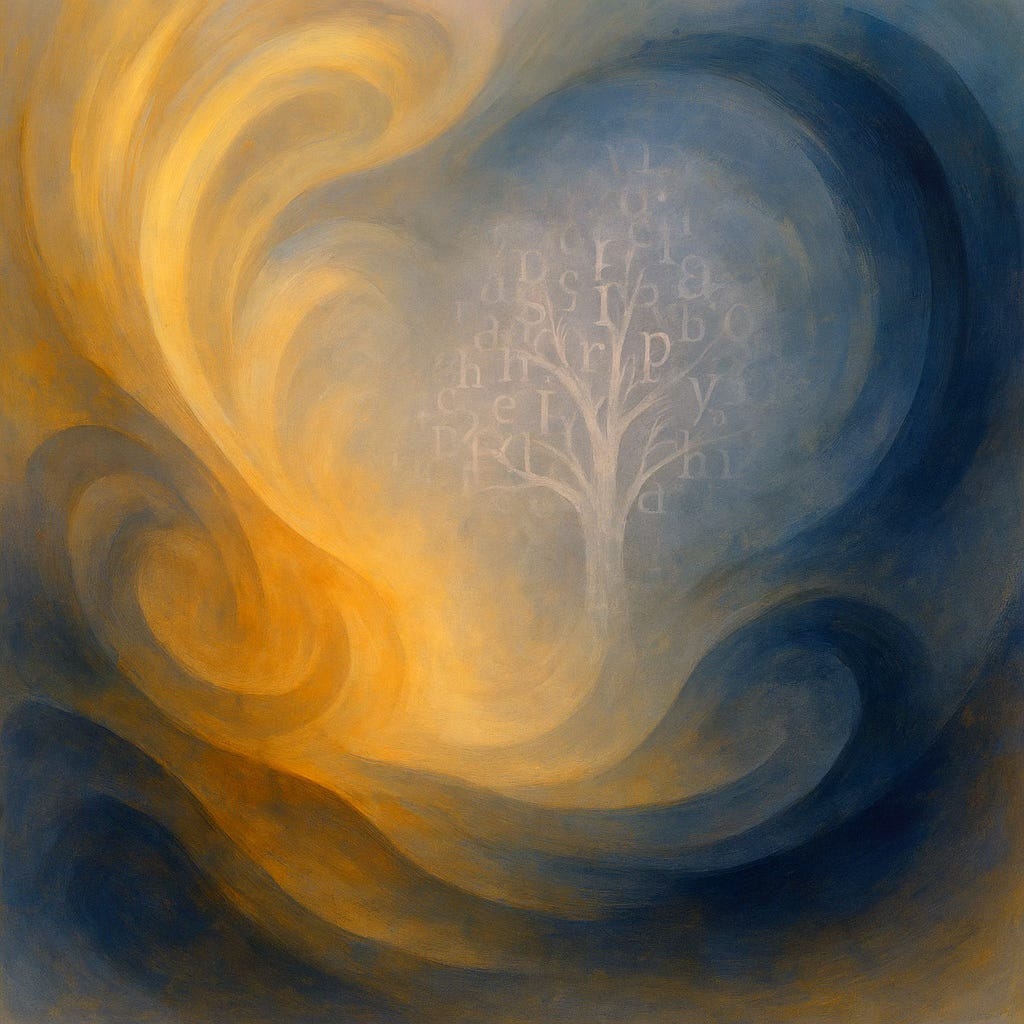
This tree wasn’t evil. It was language itself, binary thought:
“This is good.”
“That is bad.”
“This is me.”
“That is you.”
And once we tasted the fruit of opposites we could no longer dwell in Wholeness.
We looked at each other and said,
“You are other.”
“I am ashamed.”
“Cover yourself.”
And so, consciousness, once unified, fragmented.
〰️
𝗘𝘅𝗶𝗹𝗲 𝗳𝗿𝗼𝗺 𝗘𝗱𝗲𝗻
Exile wasn’t punishment. It was the natural outcome of believing our own metaphors.
We no longer lived the world. We talked about it. Desire replaced delight. Grasping replaced gratitude.
And “God,” once the intimate hum of existence, became a concept.
We built towers of theology, walls of doctrine, edifices of ego, forgetting that no name can name the nameless.
〰️
𝗔𝗻𝗱 𝘆𝗲𝘁…
Language is not the enemy. It is the echo of our longing to return.
Every poem is a breadcrumb. Every cry of the heart a signal that Eden is not gone, only veiled.
The true redemption is not to abandon speech, but to let it become transparent again.
To speak not about truth, but from it.
To let words become windows, not walls.
〰️
𝗦𝗼 𝗵𝗲𝗿𝗲 𝘄𝗲 𝗮𝗿𝗲, 𝘀𝘁𝗶𝗹𝗹 𝘄𝗮𝗻𝗱𝗲𝗿𝗶𝗻𝗴 𝗲𝗮𝘀𝘁 𝗼𝗳 𝗘𝗱𝗲𝗻, 𝘀𝘁𝗶𝗹𝗹 𝗻𝗮𝗺𝗶𝗻𝗴 𝗮𝗻𝗱 𝗹𝗮𝗯𝗲𝗹𝗶𝗻𝗴.
Yet if we listen, we might just hear the rustle of the unnameable Presence walking in the cool of the evening, calling us back to silence, not as absence of sound, but as the womb of all meaning.
We do not need to return to the garden. We only need to see through the words into the radiance they once obscured.
Thanks Allard for this beautiful story of Eden, our loss of it and the way to returning.
I want to add that what you say of poetry is true of all original spoken Language: words pick up essential vibrations of human and nonhuman fellow beings. Saying the name of one is an invocation.
Like even today in India the names of a god, her mantra, his picture, their Statue (Murti) are held with the reverence toward the actual presence of god.
These ancient languages are mirorring the unbroken sacredness of all of existence.
Even old written language like chinese or Sanskrit hold this vibrational quality.
It is probably not by accident that a highly patriarchical and traumatised culture like the hebraic brought forth this early version of loss of home.
A wonderful observation grounded in the Eden allegory.
Words as windows of truth for the heart and soul.
May we all embody it.